




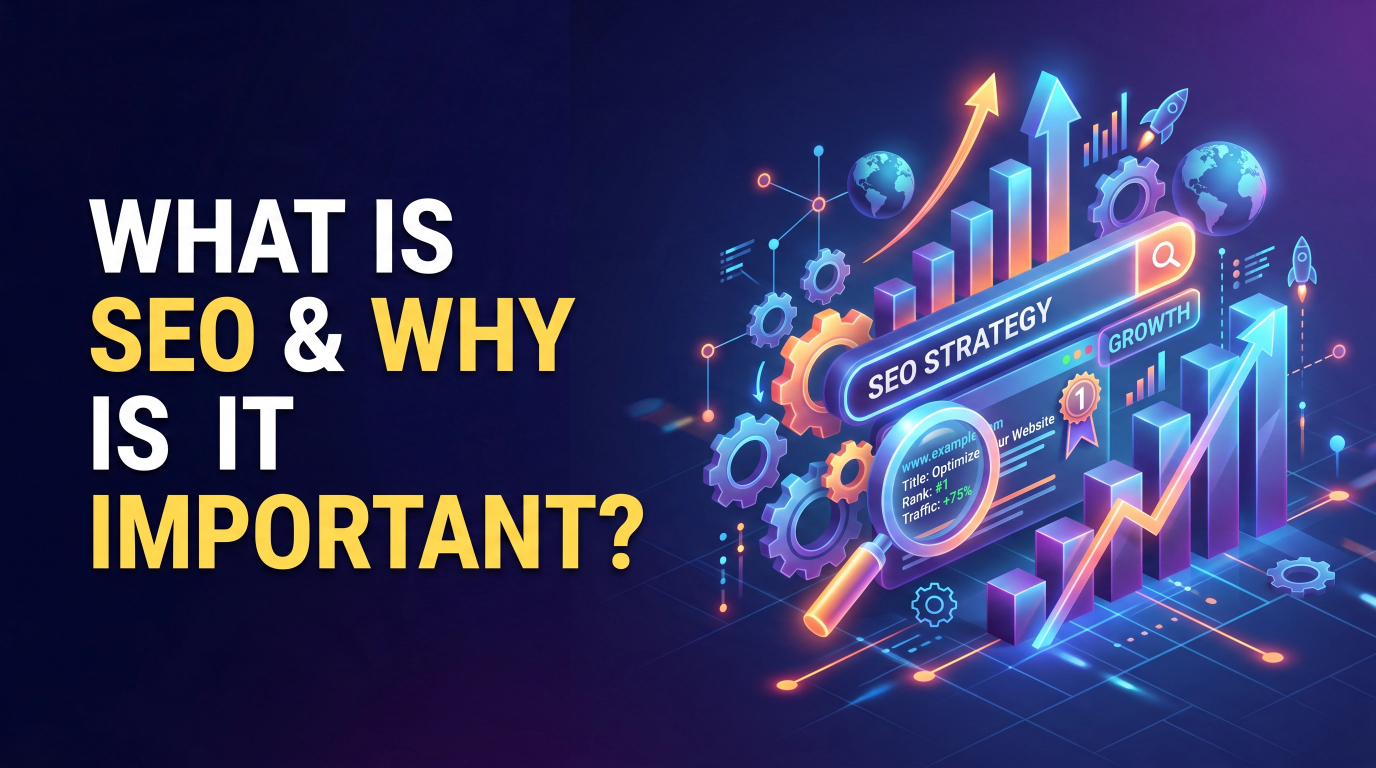
The Complete Beginner’s Guide to SEO (2026 Edition)
Introduction
Imagine opening a beautiful shop on a busy street—but forgetting to put up a sign. No matter how good your products are, people won’t walk in if they don’t know your shop exists.
The internet works in much the same way.
You can build a stunning website, write incredible articles, or sell amazing products, but if people can’t find your website through search engines, much of your effort goes unnoticed. That’s where Search Engine Optimization, or SEO, comes in.
SEO is the process of improving your website so search engines can understand it and confidently recommend it to people searching for information, products, or services. It’s not about tricking Google or stuffing pages with keywords. Modern SEO is about creating helpful content, offering a great user experience, and making your website easy to understand—for both people and search engines.
SEO has changed dramatically over the years. Today, search engines use artificial intelligence to better understand content, user intent, and website quality. People also search in more places than ever before, including Google, YouTube, Reddit, and AI assistants like ChatGPT and Perplexity. Despite these changes, the goal remains the same: connect people with the information they’re looking for.
In this guide, you’ll learn the fundamentals of modern SEO, from understanding how search works to creating content that ranks, improving your website’s technical health, and preparing for the future of search.
How Search Engines Work
Before you can improve your rankings, you need to understand what search engines actually do.
Their job is simple: help people find the best answer to their questions.
Every time someone searches for something, search engines examine billions of pages and decide which ones are most relevant, trustworthy, and useful. This process happens in just a fraction of a second.
The process can be broken down into three main stages.
Crawling
Search engines use automated programs called crawlers (or bots) to discover pages across the web. They follow links, read sitemaps, and revisit websites regularly to find new or updated content.
If search engines can’t discover your page, it can’t appear in search results.
Indexing
Once a page has been crawled, the search engine decides whether it’s worth storing in its index—a giant database of searchable web pages.
Pages that are duplicated, extremely thin, poorly structured, or blocked from indexing may never appear in search results.
Ranking
After a page has been indexed, the search engine determines where it should appear for different searches.
Contrary to popular belief, rankings aren’t based on a single factor. Search engines consider hundreds of signals, including:
- Relevance to the search
- Content quality
- User experience
- Website speed
- Mobile friendliness
- Backlinks
- Internal linking
- Content freshness
- Trustworthiness
The goal is simple: show the page that’s most likely to satisfy the user’s search.
Search Intent Matters Most
One of the biggest changes in SEO is the growing importance of search intent—the reason behind a search.
For example, someone searching for “how to grow tomatoes” wants instructions.
Someone searching for “buy tomato seeds” wants to make a purchase.
Although both searches are about tomatoes, they require completely different pages.
Understanding what people are trying to accomplish is often more important than choosing the perfect keyword.
The Four Pillars of SEO
Modern SEO rests on four core pillars. Neglect one, and your website becomes weaker overall.
1. On-Page SEO
On-page SEO includes everything you optimize directly on your website.
This includes:
- Clear page titles
- Helpful headings
- Well-written content
- Descriptive URLs
- Optimized images
- Internal links
- Meta descriptions
Your goal is to make each page easy to understand, easy to navigate, and genuinely useful.
2. Technical SEO
Technical SEO ensures search engines can access and understand your website efficiently.
Important areas include:
- Fast loading pages
- Mobile-friendly design
- HTTPS security
- XML sitemaps
- Clean site architecture
- Proper redirects
- Canonical tags
- Structured data
Think of technical SEO as building strong foundations for a house. Visitors may never notice them, but without them, everything else suffers.
3. Off-Page SEO
Off-page SEO focuses on building your website’s reputation across the internet.
The strongest signal is high-quality backlinks—links from trusted websites pointing to your content.
However, quality matters far more than quantity. A few links from respected websites are usually worth much more than hundreds of low-quality ones.
Off-page SEO also includes brand mentions, digital PR, partnerships, and positive online reviews.
4. Content SEO
Content is the heart of every successful SEO strategy.
Search engines reward websites that consistently publish helpful, original, and trustworthy information.
Rather than creating dozens of shallow articles, focus on covering topics thoroughly and answering the questions your audience actually has.
Good content should:
- Solve a real problem
- Be easy to read
- Include examples
- Stay up to date
- Be written for people first
When your content genuinely helps readers, search engines are far more likely to recommend it.
Keyword Research
Many people think keyword research is about finding words with the highest search volume.
It isn’t.
Good keyword research is about understanding what people are trying to accomplish when they search. Every search begins with a question, a problem, or a need. Your job is to create content that provides the best answer.
For example, if someone searches for “best laptops for students,” they aren’t looking for the history of laptops. They’re looking for recommendations. If they search for “how to speed up a slow laptop,” they want a solution to a problem. Understanding that difference is what separates effective SEO from guesswork.
Start With Topics, Not Keywords
Instead of obsessing over individual keywords, begin with the main topics related to your website.
If you run a gardening website, your topics might include:
- Vegetable gardening
- Indoor plants
- Composting
- Pest control
- Garden tools
From each topic, you can create multiple articles that answer different questions your audience is asking.
Find Long-Tail Keywords
Long-tail keywords are longer, more specific search phrases. While they often have lower search volume, they usually attract visitors who know exactly what they want.
For example:
- Gardening (very broad)
- Best vegetables to grow during the rainy season (specific)
- How to grow tomatoes in containers (highly targeted)
These searches are generally less competitive and often lead to higher engagement because the content closely matches the user’s intent.
Use Keyword Research Tools
Several tools can help you discover search topics and understand what people are looking for, including:
- Google Search Console
- Google Keyword Planner
- Ahrefs
- Semrush
- Moz
- AnswerThePublic
- AlsoAsked
These tools can show search volume, related questions, keyword difficulty, and trends. However, remember that they are guides—not rulebooks. Don’t ignore a valuable topic simply because a tool reports low search volume.
Use Keywords Naturally
Once you’ve chosen a target keyword, include it naturally in your page title, headings, URL, and throughout the content where it makes sense.
Avoid repeating the same phrase over and over. Search engines understand synonyms and related terms, so write naturally.
Your goal isn’t to satisfy an algorithm—it’s to help the reader.
Creating Content That Ranks
Keyword research helps people find your content. Great content gives them a reason to stay.
Search engines have become remarkably good at recognizing content that genuinely helps people. That’s why creating useful, trustworthy, and engaging content is the most important part of modern SEO.
Write for People First
Every article should answer a question, solve a problem, or help the reader make a decision.
Before writing, ask yourself:
- What problem is the reader trying to solve?
- What information are they expecting?
- Can I explain this more clearly than existing articles?
If your content leaves readers satisfied, you’re already moving in the right direction.
Demonstrate Experience and Expertise
People trust content written by someone who has real knowledge or experience.
Whenever possible:
- Share practical examples.
- Include screenshots or photos.
- Explain what worked and what didn’t.
- Use reliable sources when discussing facts or statistics.
This builds trust with both readers and search engines.
Make Content Easy to Read
Most people don’t read every word. They scan.
Help them by using:
- Clear headings
- Short paragraphs
- Bullet points
- Numbered lists
- Tables where appropriate
- Relevant images and diagrams
A well-structured article is easier to understand and more enjoyable to read.
Keep Content Fresh
Information changes over time.
Regularly review older articles to:
- Update outdated facts
- Add new insights
- Replace broken links
- Improve examples
- Expand sections where necessary
Refreshing valuable content is often more effective than constantly publishing new articles.
Build Connections Between Articles
Don’t treat every page as an isolated piece of content.
Link related articles together to help readers explore your website and help search engines understand how your content is organized.
For example, an article about “How to Start a Vegetable Garden” could naturally link to articles about composting, watering plants, or choosing gardening tools.
This creates a stronger website overall and encourages visitors to spend more time exploring your content.
Technical SEO Essentials
Even the best content can struggle if your website has technical problems.
Technical SEO focuses on making your website fast, secure, and easy for search engines to crawl and understand.
Make Your Website Mobile-Friendly
Most searches now happen on mobile devices. Your website should adapt to different screen sizes, with readable text, easy navigation, and buttons that are simple to tap.
If visitors have to zoom in or struggle to navigate your pages, they’re likely to leave.
Improve Website Speed
People expect websites to load quickly.
Slow pages frustrate users and can reduce engagement.
To improve speed:
- Compress images.
- Remove unnecessary scripts.
- Enable browser caching.
- Use modern image formats where appropriate.
- Choose reliable hosting.
A faster website creates a better experience for everyone.
Use HTTPS
Security matters.
HTTPS encrypts information exchanged between your website and its visitors, helping protect user data while increasing trust.
Today, HTTPS is considered a standard rather than an optional feature.
Create an XML Sitemap
An XML sitemap helps search engines discover the important pages on your website.
While it doesn’t guarantee higher rankings, it makes it easier for search engines to understand your site’s structure and find new content.
Add Structured Data
Structured data, also known as schema markup, provides additional context about your content.
It can help search engines understand whether a page is an article, product, recipe, event, or FAQ, and may improve how your pages appear in search results.
Technical SEO isn’t about complicated code or secret tricks. It’s about removing obstacles so search engines can easily discover, understand, and present your content to the people searching for it.
Link Building
Creating excellent content is one part of SEO. Building your website’s reputation is another.
One of the ways search engines assess a website’s credibility is by looking at the websites that link to it. These links, known as backlinks, act like recommendations. When reputable websites link to your content, they’re signaling that it’s useful and worth referencing.
However, not all backlinks are equal. A single backlink from a respected, relevant website can be far more valuable than dozens of links from low-quality or unrelated sites.
Earn Links, Don’t Chase Them
The most sustainable way to build backlinks is to create content people naturally want to reference.
This could include:
- In-depth guides
- Original research
- Useful tools or calculators
- Templates and checklists
- Infographics
- Case studies
When your content solves a problem better than existing resources, other websites are more likely to link to it.
Build Relationships
Link building isn’t just about links—it’s about relationships.
Connect with people in your industry. Participate in relevant communities. Write guest articles for reputable websites when they genuinely add value. Collaborating with others often leads to natural mentions and backlinks over time.
Don’t Forget Internal Links
While backlinks from other websites are important, the links within your own website matter too.
Internal links help visitors discover related content and help search engines understand how your pages connect.
For example, if you publish an article about keyword research, it should naturally link to your articles about content writing, search intent, and on-page SEO.
A well-connected website is easier to navigate and easier for search engines to understand.
Avoid Shortcuts
Buying backlinks, joining link schemes, or using automated link-building services may promise quick results, but they can damage your website’s reputation.
SEO is a long-term investment. Focus on earning trust rather than manipulating rankings.
Local SEO
If your business serves a specific city, town, or region, local SEO can help nearby customers find you.
Imagine someone searches for “electrician near me” or “best bakery in Lagos.” Search engines aim to show businesses that are both relevant and geographically close.
Create a Google Business Profile
A complete and accurate Google Business Profile is one of the most important parts of local SEO.
Make sure your profile includes:
- Business name
- Address
- Phone number
- Website
- Business hours
- Photos
- Services
- Categories
Keep this information up to date.
Keep Your Information Consistent
Your business name, address, and phone number (often called NAP) should be consistent across your website and online directories.
Inconsistent information can confuse both users and search engines.
Encourage Customer Reviews
Positive reviews help build trust and can improve your visibility in local search results.
Encourage satisfied customers to leave honest reviews, and respond professionally to both positive and negative feedback.
Create Local Content
If your business serves a particular area, create content that reflects your local audience.
For example, a solar installation company might publish guides such as:
- Solar Power for Homes in Abuja
- Choosing Solar Panels for Nigeria’s Climate
- Common Electrical Problems During the Rainy Season
Relevant local content helps demonstrate your expertise while serving the needs of your community.
Measuring SEO Success
SEO isn’t something you set up once and forget.
You need to measure what’s working, identify what’s not, and continuously improve.
Fortunately, several free and paid tools make this easier.
Google Search Console
Google Search Console shows how your website performs in Google Search.
You can see:
- Which search terms bring visitors
- How often your pages appear
- Click-through rate (CTR)
- Average search position
- Pages with indexing issues
It’s one of the most valuable tools for understanding your website’s search performance.
Google Analytics 4
Google Analytics helps you understand what visitors do after they arrive.
You can track:
- Organic traffic
- User engagement
- Conversions
- Popular pages
- Traffic sources
These insights help you understand whether your SEO efforts are attracting the right audience.
Track Meaningful Metrics
Don’t become obsessed with rankings alone.
A page ranking first for an irrelevant keyword is less valuable than a page ranking fifth for a keyword that brings qualified visitors.
Focus on metrics such as:
- Organic traffic
- Clicks
- Impressions
- Click-through rate
- Conversions
- Average engagement time
These metrics provide a more complete picture of your website’s performance.
AI and the Future of SEO
Search is evolving rapidly, and artificial intelligence is one of the biggest drivers of that change.
Today, people don’t just search using traditional search engines. They also ask AI assistants questions, compare products through AI-generated summaries, and expect quick, conversational answers.
Rather than replacing SEO, AI is changing how content is discovered and presented.
AI Is a Tool, Not a Replacement
AI can help with brainstorming, outlining, editing, and organizing ideas. It can improve productivity and speed up content creation.
However, publishing AI-generated content without reviewing or improving it often results in generic articles that offer little unique value.
The best content combines AI’s efficiency with human expertise, experience, and judgment.
Focus on Original Value
As AI-generated content becomes more common, originality becomes even more important.
Ask yourself:
- Does this article provide unique insights?
- Does it include real examples?
- Does it answer questions more clearly than competing content?
- Would someone bookmark or share it?
Content that offers genuine value is more likely to earn trust, backlinks, and long-term visibility.
Search Happens Everywhere
People now search on:
- YouTube
- Amazon
- TikTok
- AI assistants
Think beyond Google.
If your audience prefers watching tutorials on YouTube or discovering products on social platforms, your content strategy should reflect that.
The goal isn’t simply to rank in one search engine—it’s to be discoverable wherever your audience is looking.
Common SEO Mistakes to Avoid
Many websites struggle with SEO not because they’re missing advanced techniques, but because they’re making simple mistakes.
Here are some of the most common:
- Writing for search engines instead of people.
- Publishing thin or low-quality content.
- Ignoring search intent.
- Using misleading titles or clickbait.
- Stuffing pages with keywords.
- Neglecting mobile users.
- Ignoring website speed.
- Buying backlinks.
- Forgetting internal links.
- Publishing content and never updating it.
SEO rewards consistency, quality, and patience—not shortcuts.
Conclusion
SEO has changed dramatically over the years, but its purpose remains the same: helping people find the information they need.
Modern SEO is no longer about gaming algorithms or chasing loopholes. It’s about creating valuable content, building a trustworthy website, and delivering a great experience to your visitors.
Focus on understanding your audience, answering their questions honestly, and continually improving your website. As search engines evolve, these principles remain remarkably consistent.
Think of SEO as an ongoing process rather than a one-time task. Every article you publish, every page you improve, and every problem you solve strengthens your website over time.
The websites that succeed in the long run aren’t necessarily the ones using the latest trick—they’re the ones that consistently provide value.
Frequently Asked Questions
Is SEO still worth learning in 2026?
Absolutely. While search has evolved with AI and new discovery platforms, people still rely on search to find information, products, and services. Strong SEO helps your content remain visible across both traditional and AI-powered search experiences.
How long does SEO take to work?
SEO is a long-term strategy. Depending on your website’s age, competition, and the quality of your content, it can take several weeks to several months before you see meaningful improvements.
Does AI-generated content hurt SEO?
Not by itself. Search engines focus on the quality and usefulness of content rather than how it was created. AI can be a helpful writing assistant, but content should always be reviewed, improved, and made genuinely valuable before publishing.
Is keyword density still important?
No. Modern search engines understand context and related concepts. Instead of repeating the same keyword, focus on covering the topic naturally and thoroughly.
What is E-E-A-T?
E-E-A-T stands for Experience, Expertise, Authoritativeness, and Trustworthiness. These principles help search engines evaluate the quality and credibility of content, especially on topics that affect people’s health, finances, or safety.
How often should I update my content?
Review important pages regularly—at least once or twice a year, or whenever significant changes occur in your industry. Keeping content accurate and up to date helps maintain its value for both readers and search engines.


 US DOLLAR $ — USD
 NG NAIRA ₦— NGN
 EU EURO € — EUR
 GB POUNDS £ — GBP